Werbungskosten 2025: What Employees in Germany Can Actually Deduct
Werbungskosten (income-related expenses) are everything you spend because of your job. The tax office deducts a flat 1,230 euros of them from your gross salary automatically, with no receipts required. That figure is the Arbeitnehmer-Pauschbetrag (employee standard allowance), and it is the reason collecting receipts only pays off once your total is comfortably above it.
This guide covers tax year 2025, the return you file in 2026. Every figure below applies to that year. Where something changes from 2026 onwards, it is marked as such.
The short version
- The Arbeitnehmer-Pauschbetrag for 2025 is 1,230 euros. You get it whether or not you enter anything.
- Receipts only start paying off once your expenses total more than 1,230 euros. Every euro above that reduces your taxable income.
- For most employees the commute is the biggest single item: 0.30 euros per kilometre for the first 20 kilometres, 0.38 euros from kilometre 21, one way only, per working day.
- The home office day rate is 6 euros per day, capped at 1,260 euros a year. It counts towards the standard allowance, not on top of it.
- Work equipment up to 800 euros net (952 euros including VAT) is fully deductible in the year you buy it. Computers, peripherals and software always are, whatever they cost.
- From tax year 2026 the commuting allowance becomes 0.38 euros from the first kilometre. That does not affect your 2025 return.
What counts as a work-related expense
The definition sits in § 9 EStG and is deliberately broad: spending to acquire, secure and maintain your income. In practice, the expense has to be caused by your work.
Something you use both privately and professionally is not automatically lost. A laptop you use 60 percent for work is deductible at 60 percent. A trade journal that only makes sense professionally is deductible in full.
What does not count is private living costs. A suit for the office falls on the private side; safety boots for a building site do not. The dividing line is whether the item could reasonably be worn privately.
The standard allowance is the bar you have to clear
This is the part most guides skip past. The 1,230 euros is not granted in addition to your expenses. It is granted instead of them. The tax office compares the two:
| Deducted | |
|---|---|
| Your documented expenses come to 800 euros | 1,230 euros |
| Your documented expenses come to 1,230 euros | 1,230 euros |
| Your documented expenses come to 2,100 euros | 2,100 euros |
Only the third case was worth the effort, and only by 870 euros of extra deduction. At a marginal rate of around 30 percent, that is roughly 261 euros back.
Which suggests an order of work: calculate your commute first. For most employees it alone decides whether anything else is worth adding up.
Entfernungspauschale: the commuting allowance
For each working day on which you travelled to your erste Tätigkeitsstätte (primary place of work), you can claim the one-way distance. Not the round trip.
Tax year 2025:
| Distance | Rate per kilometre |
|---|---|
| Kilometres 1 to 20 | 0.30 euros |
| From kilometre 21 | 0.38 euros |
The shortest road connection applies. A longer route only counts if it is genuinely quicker and you actually used it.
Example: 32 kilometres one way, 220 days in the office.
- 20 km × 0.30 euros = 6.00 euros
- 12 km × 0.38 euros = 4.56 euros
- Per day: 10.56 euros
- 220 days × 10.56 euros = 2,323.20 euros
That alone clears the standard allowance by almost 1,100 euros.
The ceiling: the annual maximum is 4,500 euros. It falls away if you travel by your own car or one provided to you. If you use public transport and your actual ticket costs are higher than the allowance, you can claim the ticket costs instead.
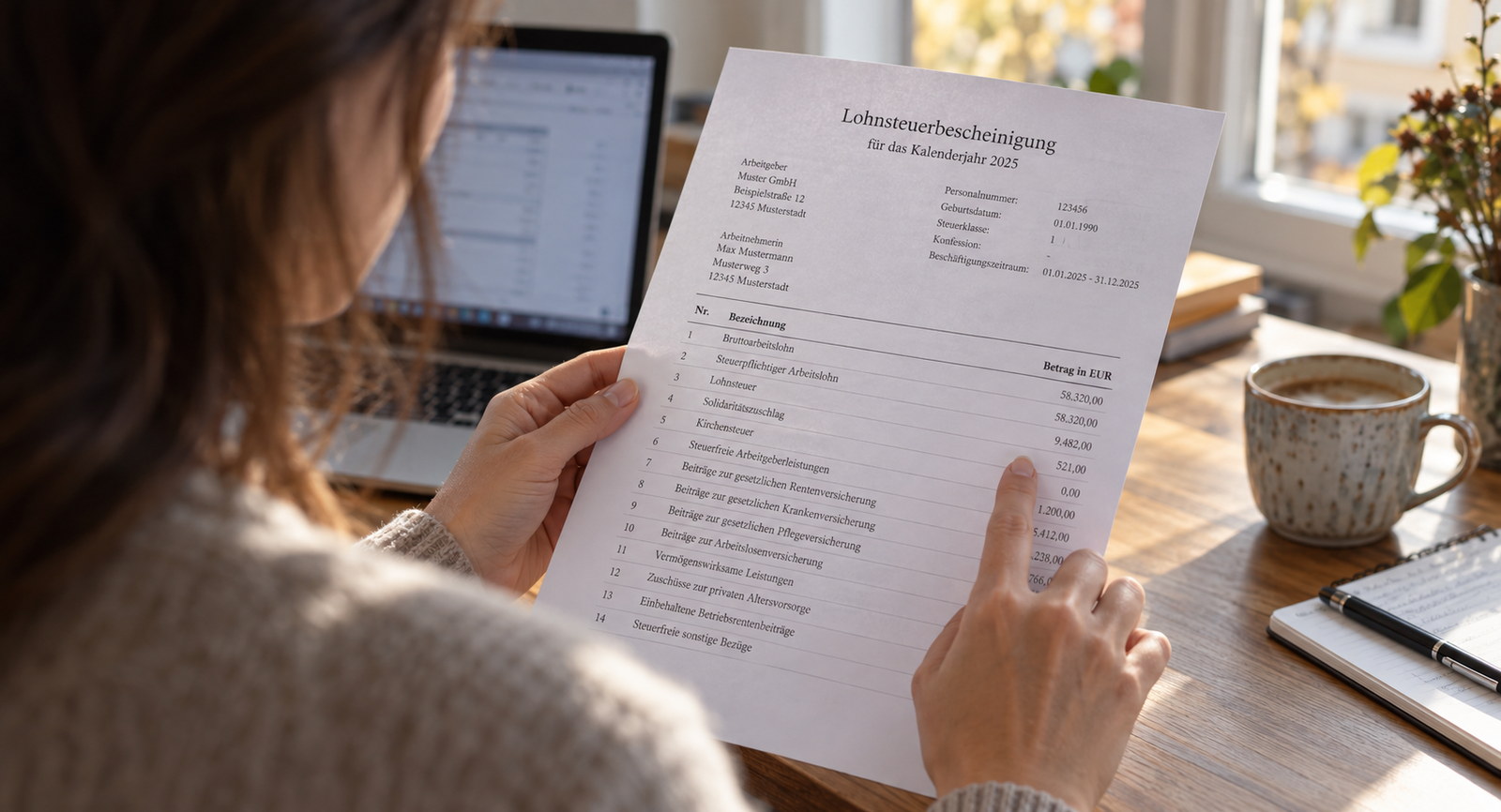
What reduces it: if your employer pays a travel subsidy and taxes it at the flat 15 percent rate, that amount reduces your commuting allowance. You will find it under number 18 on your Lohnsteuerbescheinigung (annual payroll tax statement). A tax-free travel pass under § 3 Nr. 15 EStG appears under number 17 and reduces it too.
From 2026: the Steueränderungsgesetz 2025 sets the rate at 0.38 euros from the first kilometre. The Bundesrat approved it on 19 December 2025 and it applies from 1 January 2026. Your 2025 return still uses the two-tier rates above.
Home office: day rate or study
Since 2023 there have been two separate routes, and they rule each other out on the same day.
The day rate
6 euros for each day you worked predominantly from home, capped at 1,260 euros a year, which works out at 210 days. Predominantly means more than half of that day’s working time.
You cannot also claim the commuting allowance for the same day. There is one important exception: if no other workplace is permanently available to you, for instance because your employer keeps no desk for you, you can claim the day rate even on days when you travelled to a client or to the office.
The detail people miss: the day rate is itself a work-related expense. It does not sit on top of the 1,230 euro standard allowance, it counts towards it. Someone who worked 100 days from home has 600 euros and therefore nothing more than they would have had without filing at all.
The home study
If your häusliches Arbeitszimmer (home study) is the centre of your entire professional activity, you have a choice: the actual costs of the room, apportioned by floor area, or a flat 1,260 euros a year with no itemisation.
Actual costs include a share of rent or building depreciation, service charges, electricity, heating, insurance and redecoration of the room. It has to be a separate room used almost exclusively for work. A desk in the corner of the living room does not qualify.
Work equipment
Anything you use predominantly for work: laptop, monitor, desk, office chair, professional books, tools, software.
Up to 800 euros net, meaning 952 euros including 19 percent VAT, you deduct the full amount in the year of purchase. Above that, you spread the cost over the asset’s useful life.
Computers are a special case. Since 2021 the tax administration accepts a useful life of one year for computer hardware, peripherals and software. A 1,800 euro notebook is therefore fully deductible in the year you buy it, to the extent you use it for work.
Many tax offices accept a small amount for work equipment without receipts, usually 103 euros, or 110 euros in Baden-Württemberg. Saxony and Brandenburg do not apply this practice. It is an administrative convention, not a legal entitlement.
Training, travel, job applications
Training costs are fully deductible where the course relates to your work: fees, examination fees, textbooks, travel to the venue, and for multi-day events accommodation and meal allowances too.
Meal allowances for work travel within Germany:
| Time away from home and primary workplace | Allowance |
|---|---|
| 24 hours | 28 euros |
| More than 8 hours, plus arrival and departure days | 14 euros |
These rates have been unchanged since 2020. For the same assignment at the same location, the deduction is limited to three months. If your employer provides meals, the allowance is reduced.
Job application costs count even when the application failed: postage, application folders, travel to interviews, photographs.
Doppelte Haushaltsführung (maintaining a second household) applies if you keep a second home near your workplace for professional reasons while still running your own household at your centre of life. Accommodation costs are capped at 1,000 euros a month. Moving costs, one trip home a week and meal allowances for the first three months come on top.
Membership fees for professional bodies and trade unions are fully deductible.
Worked example: when filing pays
Say you commute 18 kilometres on 180 days and work from home on 40 days.
| Item | Amount |
|---|---|
| Commuting allowance 18 km × 0.30 euros × 180 days | 972.00 euros |
| Home office day rate 6 euros × 40 days | 240.00 euros |
| Office chair used for work | 320.00 euros |
| Union membership | 180.00 euros |
| Professional books and an online course | 210.00 euros |
| Total expenses | 1,922.00 euros |
| Standard allowance | 1,230.00 euros |
| Additional deduction | 692.00 euros |
At a marginal rate of 32 percent that is around 221 euros more refund, plus the effect on solidarity surcharge and, if applicable, church tax.
Without the chair the total would be 1,602 euros and the benefit around 119 euros. With only the commute and the home office days, the total would be 1,212 euros, below the standard allowance, and the benefit zero.
What to do now
- Count your working days. Note how many days you were in the office and how many at home. The tax office expects plausible numbers, not 250 office days alongside 30 days of holiday.
- Check the distance. Shortest road connection between home and primary workplace, in whole kilometres based on the actual route.
- Find your Lohnsteuerbescheinigung. Numbers 17 and 18 tell you whether your employer subsidised your travel and your allowance will be reduced. Our guide to reading your Lohnsteuerbescheinigung explains what each figure on the printout means.
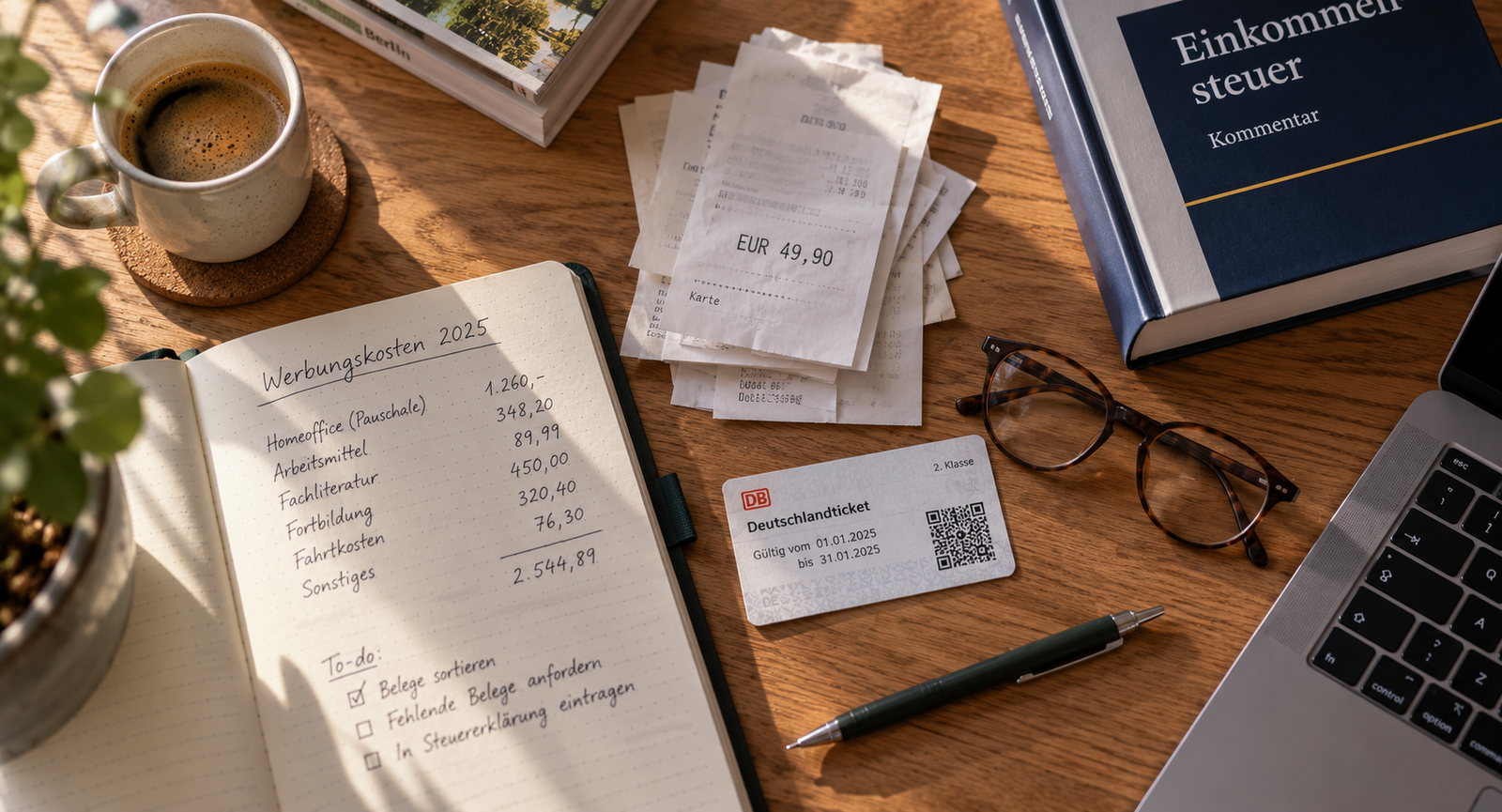
- Gather the year’s receipts. You do not submit them, but you have to be able to produce them if asked.
- Compare. If the total is under 1,230 euros, enter the items anyway. It costs nothing and completeness helps if the tax office queries anything.
How Solobooks helps
In Solobooks you enter your work-related expenses in the guided Anlage N section. For the commute you enter the distance and the number of working days, and the split between the 0.30 and 0.38 euro rates is calculated for you. Home office days feed into the same calculation, so you can see whether you have cleared the 1,230 euro allowance or not.
Your estimated refund stays visible above the form the whole time, so you can add an item and see immediately whether it changes anything. You pay only when you submit, and filing goes to the tax office electronically via ELSTER.
If you are self-employed alongside your job, that part of your income works with Betriebsausgaben (business expenses) rather than Werbungskosten. Our guide to tax deductions for freelancers covers those rules.
Frequently asked questions
Do I get the full standard allowance if I only worked part of the year? Yes. It is not pro-rated. If you started a job in November you still get the full 1,230 euros.
Can I claim the commuting allowance and the home office day rate for the same day? As a rule, no. The exception applies where no other workplace is permanently available to you.
Do I have to send receipts with my return? No. Under the current rules you submit nothing, but you have to be able to supply documents if the tax office asks.
How does a Jobticket affect things? A travel pass that is tax-free under § 3 Nr. 15 EStG reduces your commuting allowance. It appears under number 17 of your Lohnsteuerbescheinigung.
What if my home study is not the centre of my work? Then only the 6 euro day rate is available, not a deduction for the room’s costs.
Does the higher commuting allowance apply to my 2025 return? No. The 0.38 euros from the first kilometre applies from 1 January 2026 and shows up for the first time in the return for 2026, which you file in 2027.
Sources
- § 9 EStG, Werbungskosten, Gesetze im Internet
- § 9 Abs. 1 Satz 3 Nr. 4 EStG, commuting allowance
- § 4 Abs. 5 Satz 1 Nr. 6c EStG, day rate for working at home
- § 9 Abs. 4a EStG, meal allowances
- § 6 Abs. 2 EStG, low-value assets
- Bundesregierung, Steueränderungsgesetz 2025, approved by the Bundesrat on 19 December 2025
- Bundesfinanzministerium, Die wichtigsten steuerlichen Änderungen 2026
Last checked: 17 September 2026. This article is general information, not tax advice for your individual case. Legislation and official guidance change, the current version of each source prevails.
Last updated: September 15, 2026
Expert Tip
Work out your commute first. At 15 kilometres and 220 working days you are already at 990 euros and need only 240 euros from anything else to beat the standard allowance.
— Solobooks Team